AN EDUCATIONAL PROGRAMME
Surviving The Holocaust:
A unique family archive
1943: Rosy and Sigmund Kanarek and their seven-year-old daughter Zahava are arrested in Amsterdam by the SS and taken to Westerbork transit camp.
1944: The Kanareks are deported to Bergen-Belsen concentration camp. They are liberated in 1945, at the end of the Second World War.
2001: After her mother's passing, Zahava discovers a small suitcase tucked away at the back of a cupboard. Inside she finds a hidden archive of more than 200 objects, photos and documents collected and preserved by Rosy during the war. Zahava and her daughter Hephzibah begin a journey to understand Rosy's legacy...
Surviving The Holocaust:
A unique family archive


Hover for captions and click for full description
Jewish New Year Card, September 1943

This Jewish New Year card was made by my mother, Zahava, and given to her parents in September 1943. She had access to a few colouring pencils and made the card on the back of a piece of discarded card. Despite their circumstances, the family quietly marked one of the most sacred dates in the Jewish calendar.
The message, written in Dutch with some Hebrew, reads:
'Dear parents. I hope that next year we will be in better circumstances. In the meantime, Shana Tova.
Happy New Year and may you be inscribed in the Book of Life’.
The card is a reminder not only of hope, but of the determination to preserve family traditions and faith even in the darkest of times.

One Family's Story of Survival

Kanarek Family. August 1941. Amsterdam. Holland
May 1943: Rosy, Sigmund and Zahava are arrested and taken to Westerbork, a transit camp in northeast Holland.
January 1944: The Kanareks are deported to Bergen-Belsen concentration camp, where Rosy fights to protect eight-year-old Zahava, until their liberation at the end of the war, while secretly preserving a record of their lives before and during their ordeal.
80 years later: Zahava’s experiences and memories live on through Hephzibah, who has made it her mission to share this remarkable story with a new generation.
Through Zahava’s experiences, historical artefacts, and original documents, Hephzibah ensures that her family's story is never forgotten, bringing history to life for audiences today.

Kanarek Family. 1961, Holland
Amsterdam, December 1942: Faced with impossible choices, Rosy and Sigmund Kanarek entrust their sixteen-month-old son, Jehudi, to the Dutch Resistance in the hope of saving his life, not knowing if they will ever see him again. Their seven-year-old daughter, Zahava, remains with them.

“Over the years, I have spoken to audiences from every background, faith and community. The story of my family’s survival carries universal lessons about resilience, tolerance and the importance of remembering.
Sharing my family's story is both a privilege and a responsibility. It is my way of continuing the act of bearing witness, reminding us of the importance of memory, testimony and our collective responsibility to never forget.”
— Hephzibah Rudofsky
The Archive Featured:
Items from the archive have been featured in exhibitions including The Wiener Holocaust Library's Traces of Belsen exhibition and IHRA's 80 Objects / 80 Lives. Talks include the Jewish Museum London, the Imperial War Museum, The National Archives and the National Holocaust Museum.


Surviving The Holocaust: Education Programme

Since 2009, Hephzibah has brought items from Rosy's Archive to Britain's schools, in Surviving The Holocaust, an educational programme that tells the story of her family's survival in a personal account that brings history to life via her portable family museum.


I thought that the talk was amazing as it gave me an insight into the personal experiences during the holocaust. I thought that it was very well structured, delivered and interesting. I also felt very engaged in her story and I felt like I was there with the family. I also enjoyed the videos of her mother because it felt very real and interesting.
It made me feel as if I was there in the concentration camps . It also inspired me to hold on to objects important to me and my family through generations.
It was amazing to be in the room with objects that survived unimaginable circumstances. I particularly thought seeing the yellow star was incredible as it is a great piece of history.
Seeing the real objects made it feel more real and emotional. It helped me understand it actually happened to real people.
I was in awe, as this was the first time I had ever seen the actual artefacts in person and have them displayed to us rather than behind a glass screen in a museum.

Hephzibah Rudofsky (Kohn)
Hephzibah Rudofsky is a Holocaust educator, public speaker, and custodian of her family’s Holocaust archive, with more than two decades dedicated to education and remembrance. As the daughter and granddaughter of Holocaust survivors, she is committed to ensuring that personal testimony continues to connect new generations with Holocaust history.
Working alongside her mother, Lady Zahava Kohn, she created 'Surviving the Holocaust' and, since 2009, has reached more than 50,000 students across the UK, Germany, and the United States.
Her work has been widely recognised, including a guest appearance on BBC Radio 4’s Woman’s Hour, the Freedom of the City of London, and the Prime Minister’s Points of Light Award.
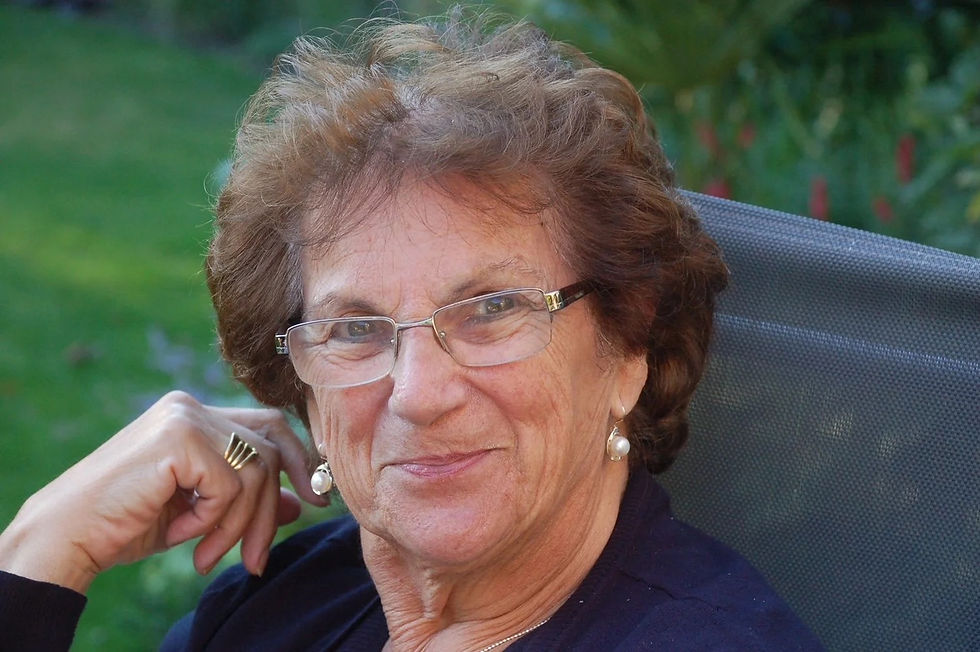
Lady Zahava Kohn MBE
Lady Zahava Kohn (Kanarek) was born in Palestine in 1935 and spent her early childhood in pre-war Amsterdam before being incarcerated in Westerbork transit camp and Bergen-Belsen concentration camp. After her liberation in 1945, she returned to Amsterdam with her family and later settled in London.
In 2001, following the death of her mother, Rosy, Zahava discovered a hidden archive of wartime documents and memories. This remarkable collection became the foundation of her memoir, Fragments of a Lost Childhood (2009). Together with her daughter, Hephzibah, she developed the 'Surviving the Holocaust' educational programme.

Rosy Kanarek
Rosy Kanarek survived incarceration in Westerbork and Bergen-Belsen with her husband Sigmund and daughter Zahava, and was reunited with her son Jehudi in 1947 after he survived the war in hiding.
After her death, it was discovered that Rosy had preserved wartime documents, artefacts, family letters and photographs in a bag left untouched for many years. The collection became an extraordinary record of her life and experiences.
Biographies

The Book:
Fragments of a Lost Childhood:
Zahava Kohn in Conversation with Ann Rosen
In 2009, Zahava published her memoir, Fragments of a Lost Childhood, based on the remarkable archive she found after her mother’s death in 2001. The book traces her journey from a traumatic childhood in concentration camps in Holland and Germany – and tells of the astonishing twists and turns that enabled her entire immediate family to survive in the bleakest of conditions.
Latest News


