Still Travelling
July 2026
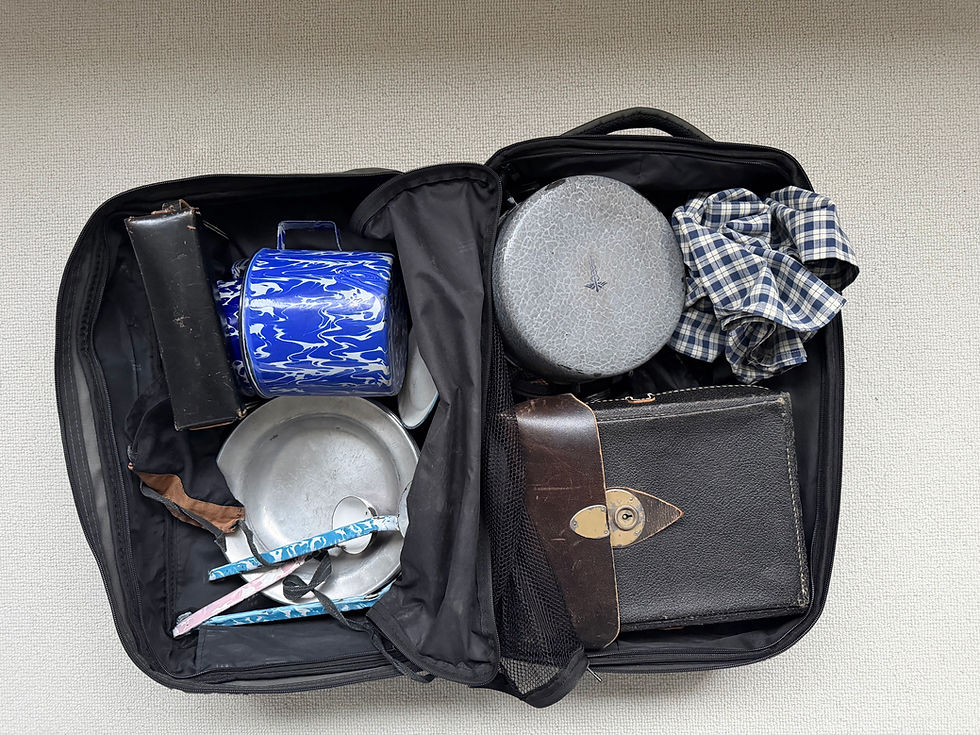
Last week, as I packed my small trolley case for another school visit, this time in Harlesden, I found myself doing what I have done so many times before: carefully packing some of my grandmother, Rosy's possessions: bowls and ladles, small enamelware pots, and the box of letters and fragile papers that accompany me into every classroom.
As I closed the case, I found myself thinking about suitcases.
Not for the first time, perhaps, but for the first time in a way that gave shape to something I had long felt but never articulated.
Suitcases - what we place inside them. What we decide to carry. And what, sometimes unexpectedly, continues the journey.
As I understand it, when my grandmother, then aged thirty -seven, was deported from Amsterdam in 1943, each person was permitted to take one case.
Rosy packed hers.
I don’t know what she chose. I don’t know what she imagined she would need, or whether she believed, even faintly, that she might one day return. Clothes. A few possessions. Photographs. Some food for the journey. Small, ordinary things that suddenly mattered - things that might still feel like home when home itself was gone.
I don’t know what became of the contents of that original case.
But years later, after her death, my mother found another case at the back of Rosy’s cupboard. It had been sitting there, closed and untouched for years.
Inside were traces of a life carried and re-carried: documents, photographs and objects preserved across decades. Among them were marbled enamelware pots and ladles which I believe Rosy had packed in Amsterdam. I cannot know this with certainty - it is an understanding pieced together through correspondence with the Archives Department at Yad Vashem.
Now, when I go into schools, I take my own small trolley case.
Inside are many of those same objects, alongside others Rosy gathered and kept through the years that followed.
I set them out on classroom tables. Some I hold in my hand. Some of the less fragile objects, including those same small pots, are passed around so that students can feel their weight and texture.
Objects that travelled from Amsterdam, through the camps and beyond.
In the classroom, these objects have a different purpose. They are not sealed behind glass or viewed from a distance. Students examine them closely, ask questions and make connections. For many, it is the first time history has felt personal.
Only recently did I begin to notice the thread of suitcases running through my family's history. Each was packed for a different journey: work, deportation, remembrance. And now my own trolley case has become part of that story.
Not long ago, I was speaking with my mother’s first cousin, Jehuda Erdman, in Los Angeles. We were talking about his grandparents, my mother’s maternal grandparents too - Rivka and Josef Guttmann.
One detail stayed with me.
When Rivka was living in Switzerland in the late 1930s, she travelled from place to place selling brushes to help support the family. She carried them in a small suitcase.
And I found myself adding another suitcase to the story.
Rivka, carrying brushes from place to place.
Rosy, packing what she could before being forced from her home, and later holding on to what she was able to keep.
A suitcase hidden at the back of a cupboard, discovered years later by my mother, Zahava -inside it, fragments of a life.
And now my own case, travelling from school to school, revealing what remains.
Rosy could never have imagined that the things she placed into her case in Amsterdam, the things she carried across camps and years would one day be laid out on classroom tables; that they would become part of how young people encounter her life, her history and her name.
In a way, they are still travelling.
