top of page

AN EDUCATIONAL PROGRAMME

Surviving the Holocaust:
A personal account bringing history to life
 

Twenty years of telling one family's Holocaust experiences to Britain's school pupils, via an astonishing archive of historical photos, documents and artefacts

BOOK A TALK
53513697283_24bc597436_o.jpeg

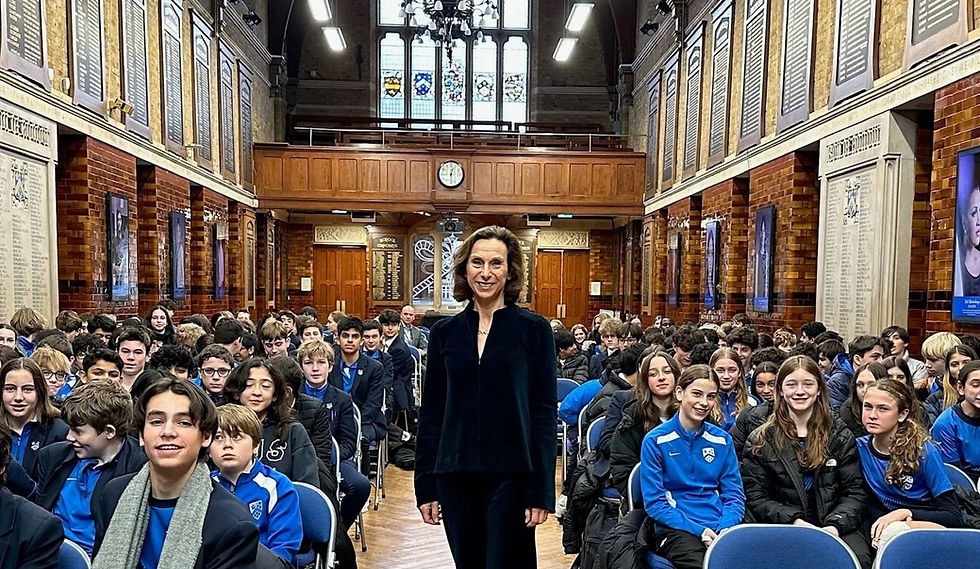
‘Surviving The Holocaust’ is both a personal testimony and an educational programme sharing the experiences of Lady Zahava Kohn, her parents, brother, and wider family during the Second World War.


Told by Zahava’s daughter, Hephzibah Rudofsky, the presentation uses a family archive of original artefacts and photos to explore Zahava’s childhood in Palestine and Holland, the family's imprisonment in concentration camps, and their journey to rebuild their lives after the war. 

LEARN MORE
I thought that the talk was amazing as it gave me an insight into the personal experiences during the holocaust. I thought that it was very well structured, delivered and interesting. I also felt very engaged in her story and I felt like I was there with the family. I also enjoyed the videos of her mother because it felt very real and interesting.
It made me feel as if I was there in the concentration camps . It also inspired me to hold on to objects important to me and my family through generations.
It was amazing to be in the room with objects that survived unimaginable circumstances. I particularly thought seeing the yellow star was incredible as it is a great piece of history.
Seeing the real objects made it feel more real and emotional. It helped me understand it actually happened to real people.
I was in awe, as this was the first time I had ever seen the actual artefacts in person and have them displayed to us rather than behind a glass screen in a museum.
article_topimage_The_Liberation_of_Bergen-belsen_Concentration_Camp__April_1945_BU4711__cr

A Story of Survival

May 1943: The Kanareks are arrested by the SS in Amsterdam and taken to Westerbork, a transit camp in northeast Holland.

December 1942: Faced with impossible choices, Rosy and Sigmund Kanarek entrust their sixteen-month-old son, Jehudi, to the Dutch Resistance in the hope of saving his life, not knowing if they will ever see him again. Their seven-year-old daughter, Zahava, remains with them.

January 1944: The Kanareks are deported to Bergen-Belsen concentration camp, where Rosy fights to protect her 8-year-old daughter, Zahava, while secretly preserving a record of their lives before and during their ordeal.

Through Zahava’s experiences, historical artefacts, and original documents, Hephzibah ensures that her mother’s story is never forgotten, bringing history to life for audiences today.

80 years later: Zahava’s experiences and memories live on through Hephzibah, who has made it her mission to share this remarkable story with a new generation.

3gen+copy.jpeg
“Over the years, I have spoken to audiences from all backgrounds and religions. The story of my mother’s survival carries universal lessons about resilience, tolerance and the importance of remembering.

Sharing my mother’s story is both a privilege and a responsibility. It is my mission to ensure that this history is never forgotten.”
— Hephzibah Rudofsky

A unique family archive

At the heart of the presentation lies a unique family archive: more than 200 objects, artefacts, photographs and documents collected by Hephzibah's grandmother Rosy Kanarek during her wartime experiences. These range from food bowls from Bergen-Belsen to postcards with hidden messages to letters to first aid kits, and were only discovered by Zahava and Hephzibah after Rosy's death.

EXPLORE THE ARCHIVE
It was a one in a lifetime moment because I was very interested in things like the yellow stars to show who the Jews were.
It made Zahava’s personal experience seem so much more real by being able to see everything she had in person. Sometimes when you hear these stories it’s easy to just think ‘that’s a sad story’ but then move on, by seeing them all in person it makes the whole holocaust seem more intense and real and harder to ignore.
Mind blowing, like a personified museum made for students to look at in school. It was a great touch to the presentation and very interesting.
It made me feel as if I was there in the concentration camps . It also inspired me to hold on to objects important to me and my family through generations.
It was extremely moving to see these real objects and artefacts, in school we learn about the Holocaust through textbooks, these artefacts made it feel a lot more real than learning about the Holocaust from those textbooks.
It was amazing to be in the room with objects that survived unimaginable circumstances. I particularly thought seeing the yellow star was incredible as it is a great piece of history.
I thought the letters were extraordinary and I couldn't quite comprehend that these things had actually been in the camps, stayed with these people all this time and now I got to see them. I also thought the fact that they kept the bowls was very interesting and though it may seem mundane to some, I found it fascinating and very sad looking at the scrapes on the bowls and knowing that once, there were people scraping them dry because they had so little to eat.
I think it was very surreal to see these items in person because it is like a bit of the past with you right now and then you can almost imagine the person who had the item with it. It was so cool to see something that actual real people during the holocaust time had touched them and used them and now we were seeing them and learning about them all these years after.
It was almost surreal because when you see the artefacts, the reality hits you that these were personal possessions and objects that were used by the holocaust survivors. It also gives you more context because in lessons it may be hard to grasp the ideas presented if you don’t have physical evidence.
it was just insane to think that people actually had these during that time and it ended up under the roof of our school.
Seeing the real objects made it feel more real and emotional. It helped me understand it actually happened to real people.
I was in awe, because I couldn’t comprehend that all the artefacts I was seeing had actually been preserved for all that time.
It was incredible to see these, as they have been preserved for a long time. However, the some artifacts including the yellow star, were chilling as they are a physical reminder of what happened.
It made the truth so much more shockingly real. We only really hear about the Holocaust being talked about in very little detail - and the child of a Holocaust survivor presenting us with first-hand evidence really put the facts in front of us.
I was in awe, as this was the first time I had ever seen the actual artefacts in person and have them displayed to us rather than behind a glass screen in a museum.

Latest News

bottom of page